Authors Can Defend Against AI Allegations With ‘Paper Trail’ Tools. Is It Enough?
As the publishing industry wrestles with paranoia over the provenance of manuscripts, writers are caught in an impossible bind.
AI News · Research & Tools
AI research news: new papers, benchmarks and breakthroughs from labs and universities, explained in plain English.
363 stories · Updated
Featured
As the publishing industry wrestles with paranoia over the provenance of manuscripts, writers are caught in an impossible bind.
This research involved the study of an application of Case-Based Reasoning (CBR) in the field of academic advising. Academic advisement has been recognised as an important function of higher education. However, there is a widespread desire to improve the advisement services provided by many educational institutions…
Normative competence, the ability to infer socially enforced expectations from interaction and adjust behavior accordingly, is essential for agents operating in unfamiliar human communities. Yet existing evaluations largely test whether agents can recognize or apply norms they may already know, rather than whether…
E-commerce supply chains generate large volumes of customer feedback and operational data that remain underutilized in inventory management. Traditional inventory classification techniques such as ABC analysis rely primarily on annual dollar usage, while multi-criteria inventory classification (MCIC) methods extend…
Scaling test-time compute has proven highly effective at improving LLM reasoning. A popular method is best-of-n sampling, where a model generates many candidate solutions and one is selected. This motivates the question: how can we select the best candidate? When humans make choices, we find it more natural to compare…
363 stories
LLM agents do not learn from corrections across sessions. A user fixes the same mistake at the start of every conversation. Existing agent memory systems primarily handle facts, such as preferences, entities, and conversational history, rather than procedural knowledge. We present Forge Decision Context (forge_dc), a…
Intra-weight injection lets one model change another model's behaviour by editing its weights directly, without gradients. Such edits can range from altering lexical associations to enforcing output formats or updating factual knowledge. Despite growing interest in these approaches, there has been no systematic way to…
Interactive debuggers are indispensable to human software development, yet coding agents overwhelmingly rely on edit-execute-observe loops, using common bash tools, test scripts, and print statements to debug via repeated shell commands. Stepping through a debugger provides live access to runtime state, which may…
Speculative decoding has become a standard way to accelerate LLM inference: a lightweight drafter proposes tokens that the target verifies in one parallel pass. Existing drafters face trade-offs that limits their speedups: autoregressive drafters generate tokens one at a time, so drafting cost grows with draft length…
We study backtracking counterfactual inference for Structural Causal Models (SCMs) through the lens of optimal transport. In SCMs, a factual observation generally induces a posterior distribution over exogenous variables, making counterfactual inference inherently distributional. We introduce two complementary…
Clients and proxies in front of an LLM engine retry calls that time out. After a transient overload, these retries can keep the engine from recovering even when calls arrive below its capacity. Since the engine may keep computing for clients that have left, propagating cancellation looks like the natural remedy. In…
Conversational recommender systems often treat user sessions in isolation, limiting their ability to capture how user intent evolves over time. While large language models (LLMs) have improved semantic understanding, they are typically used as isolated components, without addressing how memory, retrieval, and…
Most LLM architectures have fixed compute demands determined at training time. We propose a novel architecture that combines the Mixture-of-Experts architecture with shallow experts and a novel dynamic-depth system to make the extent of a forward pass dynamically adjustable. Our approach lets the model automatically…
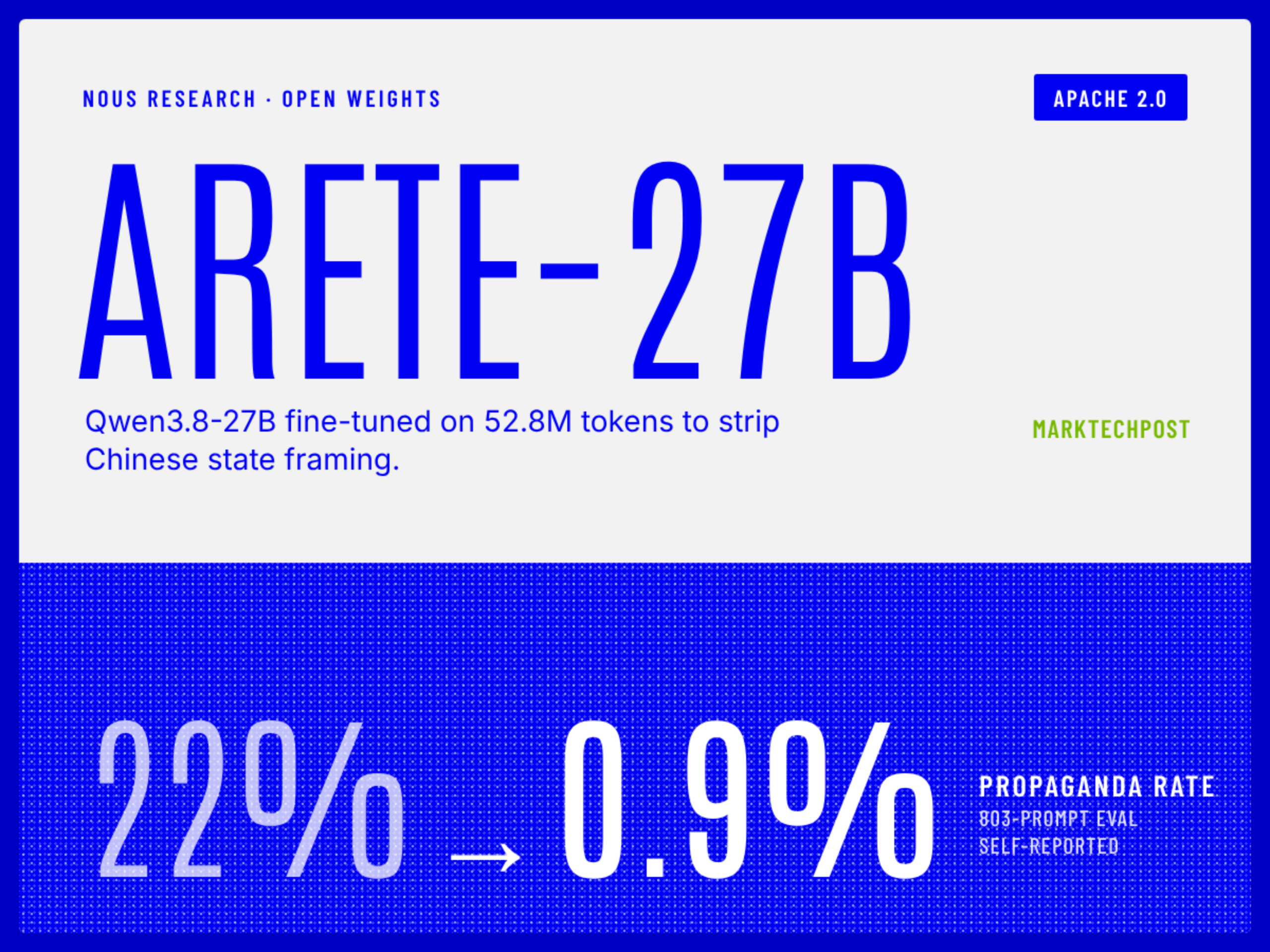
Nous Research released Arete-27B, an Apache 2.0 fine-tune of Qwen3.8-27B. On Nous’s 803-prompt eval, propaganda answers fell from 22% to 0.9% while Hermes Bench stayed flat at 65.60%. The post Nous Research Releases Arete-27B that Cuts Qwen3.8-27B Propaganda From 22% to 0.9% appeared first on MarkTechPost .