Interpretation of verified reporting. Facts and interpretation are kept apart.
What 320 AI Headlines in Three Weeks Reveal About Who Sets the Agenda
Half of the stories on our wire were about AI products and research, a quarter came straight from AI labs, and OpenAI appeared in more headlines than any other company.
Stories collected by the AITN wire between October 13 and November 2, 2026, by section.Graphic: AITN Data Desk
Over 21 days, from October 13 to November 2, 2026, the AI & Technologies News wire collected 320 headlines from 15 sources: news sites, AI lab blogs, arXiv and Hacker News.[1] We sorted every story into our eight sections and counted who published it and which companies it named.
Three findings stand out. AI products and research made up 51% of all stories. AI labs published nearly a quarter of the headlines themselves. And OpenAI, with ChatGPT, appeared in 38 stories, ahead of Google with 25 and Anthropic with 21, although 24 of those 38 came from OpenAI's own news feed.
The wire reads 16 RSS and Atom feeds every 30 minutes. General news feeds pass through a keyword filter that keeps only AI-related stories, and any item that is a video is dropped. A classifier then assigns each story to one of 62 topics, using keywords in the headline and summary.[2]
One feed, VentureBeat, returned a rate-limit error (HTTP 429) on every crawl in this period, so the analysis covers the other 15 sources.
Each headline passes through the same four steps before it is counted.Graphic: AITN Data Desk
AI news dominates the wire
More than half of the stories, 164 of 320, landed in AI News. Tech News followed with 63, then Business with 35 and Science with 31.
AI News holds 51% of the wire
Stories by section, October 13 to November 2, 2026 (n = 320).Source: AITN wire dataShow the data
Category
Stories
AI News
164
Tech News
63
Business
35
Science
31
Industry
12
Insights
8
Reviews
4
Guides
3
The three smallest sections, Insights, Reviews and Guides, are formats rather than topics. News feeds rarely carry hands-on reviews or tutorials, so these sections depend on our own reporting more than on the wire.
Large language models lead the topics
Within AI News, large language models were the busiest topic with 47 stories, ahead of generative AI with 41. AI agents and AI research had 28 each. Outside AI News, the largest topics were research papers explained (24), AI business (21), Big Tech (18) and chips (17).
Who supplies the headlines
News outlets supplied just under half of the stories. AI labs publishing on their own blogs supplied almost a quarter: OpenAI alone posted 29 items, Hugging Face 22 and NVIDIA 16.
Stories by type of source
Source type
Stories
Share
Largest sources
News outlets
158
49.4%
TechCrunch 39, The Guardian 29, Ars Technica 26
AI lab blogs
78
24.4%
OpenAI 29, Hugging Face 22, NVIDIA 16
Research papers
48
15.0%
arXiv cs.AI 24, arXiv cs.CL 24
Community
36
11.3%
Hacker News 36
Total
320
100%
15 sources
Shares do not add to exactly 100% because of rounding.
Lab blogs are primary sources: they announce products, models and research directly. They are also written by the companies they describe. That is why our editorial policy asks reporters to confirm lab claims before a story leads the site.[3]
The companies in the headlines
We counted a story for a company when its headline or feed summary named the company or one of its main AI products. A story that names two companies counts for both.
Stories naming each company or its main AI product
Company
Names counted
Stories
Share of 320
OpenAI
OpenAI, ChatGPT
38
11.9%
Google
Google, Gemini, DeepMind
25
7.8%
Anthropic
Anthropic, Claude
21
6.6%
Nvidia
Nvidia
19
5.9%
Apple
Apple
7
2.2%
Meta
Meta
7
2.2%
Microsoft
Microsoft
6
1.9%
OpenAI's lead is largely a source effect. Its news feed is one of the most active on the wire, and 24 of the 38 stories that named OpenAI or ChatGPT came from that feed. Anthropic, which has no feed on the wire, reached 21 stories entirely through outside coverage, eight of them via Hacker News. Google sat in between: 6 of its 25 stories came from the Google DeepMind blog.
Little overlap between outlets
Our duplicate check compares headlines from different sources published within 36 hours of each other. In this period it found no story that two sources ran with closely matching headlines.
That does not mean outlets ignored each other's news. The check is strict, publishers write very different headlines for the same event, and a quarter of the wire is labs announcing their own work. It does mean that a "most covered" ranking built only on headline overlap carries little signal yet. Our Trending and Most Read lists say this on the page.
How long the stories are
For 127 stories (excluding research papers) we could count the words on the article page. Their median reading time was 4 minutes and the average 4.6 minutes, at 230 words per minute. Other pages blocked automated reading or loaded their text with scripts, so we left them out rather than guess.
Limits of this analysis
One missing source. VentureBeat could not be read during the period because of rate limiting.
Keyword classification. Topics come from keywords, not editors. Some stories land in the wrong place; a story about Ryanair weighing pay freezes, for example, was filed under Generative AI because its summary mentioned AI.
Selection by the feeds. Hacker News stories enter the wire only with 80 or more points, and general news feeds only when they mention AI.
A short window. Three weeks can be shaped by a few large launches. We will repeat this count each quarter.
Questions about the method, or a correction to report? Email the Data Desk at data@aitechnews.example.
The AITN Data Desk builds the trackers, charts and datasets behind AI & Technologies News. Every figure it publishes comes with its method and a dataset you can check. It works from the newsroom's own crawl of 15 news, lab and research sources.
Building on a human-led thematic analysis of clinical life-story interviews (> 150,000 words) with inpatients with Borderline Personality Disorder, this study examines the capacity of large language models (OpenAI's GPT, Google's Gemini, and Anthropic's Claude) to support qualitative clinical analysis. The models'…
By Marcin Moskalewicz, Anna Sterna, Karolina Dro\.zd\.z, Kacper Dudzic, Marek…arXiv cs.CL1 min read
OpenAI, Google, Microsoft, and Anthropic say they will adopt a new standard that publishers can use to opt out of being scraped by AI, as reported earlier by Search Engine Roundtable. With this control, publishers can apply their AI training preferences across multiple AI companies, instead of setting them…
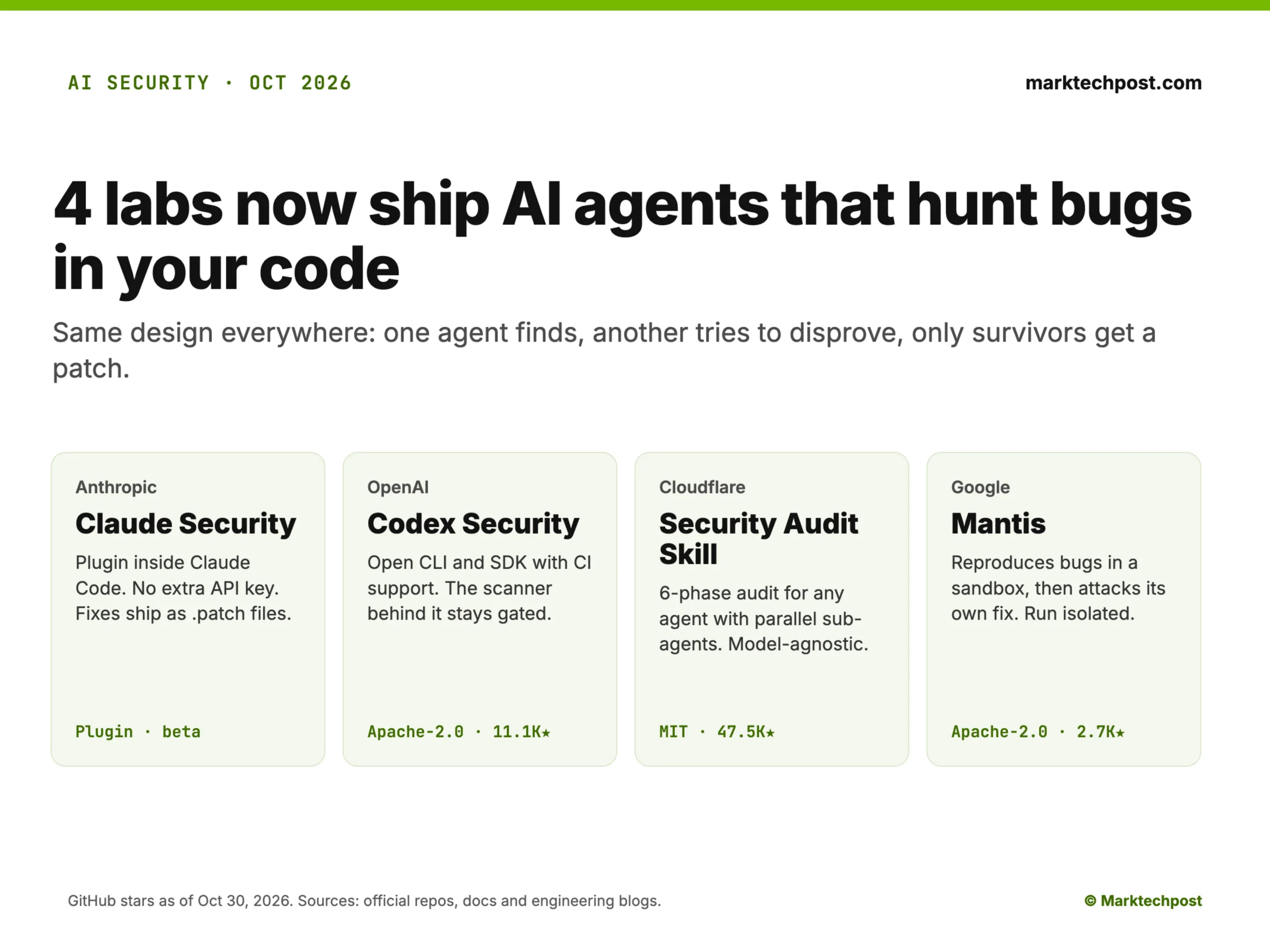
Anthropic, OpenAI, Cloudflare and Google each released an AI agent that hunts security bugs in source code. All 4 use the same find, disprove, then patch loop. Here is how they differ, plus 12 more tools. The post AI Security Agents Compared: Claude, Codex, Mantis, Cloudflare appeared first on MarkTechPost .
OpenAI is now valued at $1.25 trillion in a new round of funding that has raised another $11 billion, according to Bloomberg. That would make it one of the world's most valuable companies, not long after raising $122 billion from investors in March at a valuation of $852 billion. Echoing FT and Wall Street Journal […]
AI usage keeps climbing, but spending has stalled. Price cuts and smarter cost controls among the biggest spenders could challenge investor assumptions about AI hypergrowth.
Democrats should drag Sam Altman, Dario Amodei and Elon Musk before the world and make them explain just what it is they’re trying to do and why The AI industry had a bad night last week. The Democrats’ sweeping midterms victory is a rebuke of Donald Trump , the industry’s most powerful champion. Continue reading...
China's intelligence agency recruited Megaspeed executive Alice Huang to spy on Nvidia CEO Jensen Huang, according to The New York Times. The Ministry of State Security (MSS) enlisted her to glean information about American AI chips and "potentially influence the company to push for its most advanced chips to be made…